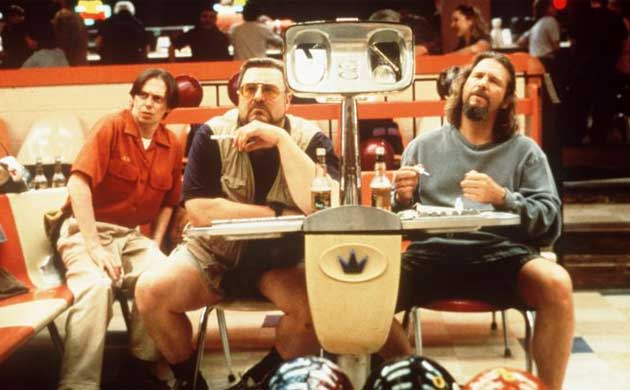
The Coen Brothers’ 1998 film The Big Lebowski was generally well received, although considered a mild follow-up to their Oscar-winning 1996 film Fargo. Their take on the Raymond Chandler private detective novel, the film is obtuse, convoluted, and downright head-scratching. I can admit to not comprehending the plot until nearly the fifth viewing, a fact that has led many critics to dismiss the film as intentionally abstract, with Variety critic Todd McCarthy explaining, “The Big Lebowski… nonetheless adds up to considerably less than the sum of its often scintillating parts, simply because the film doesn't seem to be about anything other than its own cleverness.” Carolyn Russell, in her book on the Coen Brothers, denounces the film as “dummied-down Coen brothers,” while R. Barton Palmer, in his study of the duo, only mentions the film in passing. And yet, the film has amassed a phenomenally loyal following, complete with a fan group that puts on a yearly “Lebowski Fest” to celebrate everything about the film (literally, everything). In fact, “Lebowski Fest” has outgrown its humble origins, springing up in various forms across the country. Clearly, the viewing public has found something in The Big Lebowski that has exceeded the critical engagement with the film, and perhaps even the filmmakers own intentions. The film has literally created a world of its own, in which people wear Lebowski inspired clothing and work unconventional sayings like “human peraquot” and “nobody fucks with the Jesus!” into everyday conversation.
As an avid Lebowski disciple, I have, in the past, found it difficult to approach the film with a critical mindset. It becomes impossible not to address the film on its own terms, literally its own vernacular, as a recent editorial in The Daily Nebraskan displays to an embarrassing degree. As a result, critical discussion of the film has been decidedly lacking. What attempts people have made at addressing the film in a critical, theoretical way only come off as forced and contrary. One critic even went so far as to describe a single shot of Larry Sellers as “not only erotic, but homoerotic.” As is the case with the vast majority of Coen Brothers film, it is difficult to latch onto any kind of critical thread that would allow the film to be read in any other way than the one that is superficially presented. There are clearly themes, tropes, and ideas that are consistent throughout their oeuvre, but insistence on any one of these ideas in too great a detail (or with too much seriousness) seems not only silly, but also perhaps counter-productive. So then how do we account for the rabid fandom that surrounds everything Lebowski?
In high school, I had a friend who would watch The Big Lebowski every day when he came home from school. Even if he did not pay constant attention to it, he claimed it was nice to have someone to hang out with. In fact, “hanging out” with the Dude is perhaps the penultimate way to explain one’s love for this film. In many ways, this is indicative of the entire Coen Brothers operation. The dearth of serious, critical discussion of the Coen Brothers films, and The Big Lebowski as a prime example, is a result of the sheer surface-oriented nature of their work. The Coen Brothers are nothing if not post-modern filmmakers. Their films are perfect examples of Baudrillard’s vision of representationless hyperreality. As John Storey explains in his discussion of Baudrillard,
If there is no real behind the appearance, no beyond or beneath, what can be called with validity a representation? For example, given this line of argument, Rambo does not represent a type of American thinking on Vietnam, it is a type of American thinking on Vietnam. Representation does not stand at one remove from reality, to conceal or distort, it is reality.
The fact that the film is presented in a way that follows through on the logic of hyperreality makes the representational, critical readings of the film so decidedly off-base. The experience of watching the film becomes nothing more and nothing less than “hanging out.”
And in this same way, critical readings of the film that attempt to deconstruct what the film “represents” do too much work. The Coens infuse their films with a level of pop culture knowledge that is on level with the work of Quentin Tarantino, albeit in a far less showy fashion. But their referencing does not get at a secondary meaning; it is meaning itself. In his loving documentation of the creation of The Big Lebowski, friend of the Coen Brothers William Preston Robertson explains, “Yes, the sprawling breadth of influences and references in The Big Lebowski renders it nothing less than a pop cultural potpourri, if not an out-and-out hodgepodge. And yet, if it is a hodgepodge, it is one not without some sense to it, inasmuch as the metropolis of Los Angeles is exactly that – a hodgepodge. With some sense to it.” The film does not represent Los Angeles and a collection of its weird inhabitants, it is Los Angeles and its weird inhabitants made real.
For many, this makes the work of the Minnesotan brothers decidedly vacuous and frivolous: style over substance. J. Hoberman originally described the Coen Brothers first film Blood Simple as containing, “the heart of a Bloomingdale's window and the soul of a résumé.” Even if the style is the substance, as I have argued, it is still difficult to reconcile this sort of engagement with The Big Lebowski’s fanatic following. Certainly the devotion surrounding the film is unique even in the world of the Coen Brothers, but it is perhaps understood as an immanent reaction to the superficial nature of the film itself. In not presenting a system of representation in which meaning is to be found below the surface, The Big Lebowski invites us to travel along the surface and inhabit its reality. In fact, it is in this refusal to submit to an ideological system that makes The Big Lebowski such a radical aberration. For on its surface (surface as the core), the film is a testament to the superiority of inaction, indifference, and the rejection of grand narratives that have, cinematically, traditionally provide meaning.
Jeffrey Lebowski, the Dude, is an unconventional hero. He does not have a job, a family, a purpose, life goals, or any of the other facets that make someone a dutiful subject of the capitalist world. The only known benefactors of his implied nest egg are the local bowling alley, the local drug dealer, Ralph’s, and Smirnoff and Kahlua. He is a self-avowed pacifist, member of the Seattle 7, author of the Port Huron statement, and all-around anti-fascist. Like Bartleby, he prefers not to. He cannot fall into the dialectical rationality that sustains the grand narratives because he does not engage at all. In reality, his inaction is the most truthful opposition to the capitalist system available, a fact that makes his presence on the screen (and as the hero) so interesting. In this sort of superficial reading, the following the film has attained begins to make sense. If the Dude is a reality, a friend that you can hang out with after school, he also provides an outlet for the stress of existence within the capitalist framework. As the Stranger explains in the film’s finale, “It’s good knowing he’s out there, the Dude, takin’ her easy for all us sinners.” He is opposition made real. And thus, the process of radically giving one’s self over to the film makes this opposition a reality to us.
This is the remarkable, unintended result of the superficial nature of The Big Lebowski. While ostensibly rejecting any kind of reading that digs below the surface, that searches for meaning or purpose within the film’s convoluted plot, it actually invites us to engage in a new way. The surface becomes the depth. The Dude is the physical embodiment of rejection, but one that can only be engaged through lines of dialogue, jelly shoes, and a flippant disrespect for authority. There is no need to go deeper. This also explains the strange nature of the Coen Brothers work, one that I have long tried to understand. Their films are affectively pleasurable in a way that makes repetitive viewings almost mandatory. Granted, this may not be universal, but I find it incredibly easy to watch their work over and over again. The catch is that I am not doing so to figure anything out or to find a hidden line of argument. Instead, I do so to inhabit a feeling, a sensation of reality in the world being presented, even if it is clearly artificial. Films like The Big Lebowski and Fargo become real worlds in a way that more philosophically infused works fail to do.
For many, this makes the work of the Minnesotan brothers decidedly vacuous and frivolous: style over substance. J. Hoberman originally described the Coen Brothers first film Blood Simple as containing, “the heart of a Bloomingdale's window and the soul of a résumé.” Even if the style is the substance, as I have argued, it is still difficult to reconcile this sort of engagement with The Big Lebowski’s fanatic following. Certainly the devotion surrounding the film is unique even in the world of the Coen Brothers, but it is perhaps understood as an immanent reaction to the superficial nature of the film itself. In not presenting a system of representation in which meaning is to be found below the surface, The Big Lebowski invites us to travel along the surface and inhabit its reality. In fact, it is in this refusal to submit to an ideological system that makes The Big Lebowski such a radical aberration. For on its surface (surface as the core), the film is a testament to the superiority of inaction, indifference, and the rejection of grand narratives that have, cinematically, traditionally provide meaning.
Jeffrey Lebowski, the Dude, is an unconventional hero. He does not have a job, a family, a purpose, life goals, or any of the other facets that make someone a dutiful subject of the capitalist world. The only known benefactors of his implied nest egg are the local bowling alley, the local drug dealer, Ralph’s, and Smirnoff and Kahlua. He is a self-avowed pacifist, member of the Seattle 7, author of the Port Huron statement, and all-around anti-fascist. Like Bartleby, he prefers not to. He cannot fall into the dialectical rationality that sustains the grand narratives because he does not engage at all. In reality, his inaction is the most truthful opposition to the capitalist system available, a fact that makes his presence on the screen (and as the hero) so interesting. In this sort of superficial reading, the following the film has attained begins to make sense. If the Dude is a reality, a friend that you can hang out with after school, he also provides an outlet for the stress of existence within the capitalist framework. As the Stranger explains in the film’s finale, “It’s good knowing he’s out there, the Dude, takin’ her easy for all us sinners.” He is opposition made real. And thus, the process of radically giving one’s self over to the film makes this opposition a reality to us.
This is the remarkable, unintended result of the superficial nature of The Big Lebowski. While ostensibly rejecting any kind of reading that digs below the surface, that searches for meaning or purpose within the film’s convoluted plot, it actually invites us to engage in a new way. The surface becomes the depth. The Dude is the physical embodiment of rejection, but one that can only be engaged through lines of dialogue, jelly shoes, and a flippant disrespect for authority. There is no need to go deeper. This also explains the strange nature of the Coen Brothers work, one that I have long tried to understand. Their films are affectively pleasurable in a way that makes repetitive viewings almost mandatory. Granted, this may not be universal, but I find it incredibly easy to watch their work over and over again. The catch is that I am not doing so to figure anything out or to find a hidden line of argument. Instead, I do so to inhabit a feeling, a sensation of reality in the world being presented, even if it is clearly artificial. Films like The Big Lebowski and Fargo become real worlds in a way that more philosophically infused works fail to do.
It is in this context that the radical following The Big Lebowski has attained must be conceptualized. While certainly the dialogue holds its own radical appeal, it does not begin to explain the fascination people have with becoming-Dude. They do not literally have to become jobless, pacifistic, etc, but rather come into a “zone of proximity” to the Dude by which they absorb the processes of the Dude and, in a way, gain from those processes. Naturally, this becoming is not a process that every viewer will want to engage with, and thus, The Big Lebowski is best described as a cult-film followed by a niche crowd. Critically, we could argue that those that seek opposition to the status quo are minimal, and thus, The Big Lebowski’s appeal is not universal. As a member of the Lebowski Fest Forums so elegantly argues, “I submit that, if indeed EVERYBODY liked THE BIG LEBOWSKI, then those of us who hang around here probably wouldn't…I don't suppose anybody here frequents a forum dedicated to ‘The Titanic’ - am I wrong?” This speaks to an elemental nature of fandom, one that privileges a position outside the norm.
This is not to say that Lebowski fans are small in number and isolated in nature. In reality, although the film is now a decade old, The Big Lebowski only seems to be gaining steam. To take Lebowski Fest as a barometer, what started as a yearly gathering in Louisville, Kentucky has spread to Las Vegas, Los Angeles, New York, Austin, Seattle, Chicago, and London. In total, 17 Lebowski Fests have been held, and Lebowski Fest 7 (of the original lineage, held in Louisville) is planned for July of this year. The fest has literally gone global, and each Fest gains more and more attention. Lebowski Fest attendees are referred to as “Achievers,” in reference to the Little Lebowski Urban Achievers from the film. The Achievers receive shirts with said title printed on the front and it is their responsibility to get the shirt photographed in the most distant lands and with the most famous people.
What is remarkable is the extent to which fans have taken a film from the oft-accused nihilistic and cynical Coen Brothers and turned it into an absolutely positive experience. Lebowski Fest is above all about camaraderie and friendship. One attendee of Lebowski Fest: Chicago described the experience, "It cuts across generations, from college-age kids to 'Nam veterans…It's really cool how they all can get along, shouting out lines and having a common bond with the movie. It's like an instant attachment. For a weekend, it's a shelter from the rest of the world." Enjoying the film is not simply a good time with friends, but a way to escape the pressures of everyday life. The Dude’s aura is infectious, and if only for a weekend, thousands of people can enjoy the life of an unemployed stoner, takin’ her easy.
This is not to say becoming-Dude is an experience that only occurs at a given place and time, with other followers. At the Lebowski Fest forums, which have 2,550 members, there is an ongoing discussion about members using Lebowski dialogue in everyday speech. This is a normal occurrence, particularly amongst fans, but the Achievers do it knowing full well (and in some cases hoping) that their audience does not get the reference. In that case, the Achiever has achieved a sense of superiority over the “fucking amateurs.” It is difficult to conceive of any film or media object that was intended to create this sort of fellowship, especially a decade after its release. Yet, as many Lebowski fans will argue, the film has something new to offer with each viewing. The dialogue gets better with age, and usage, and being part of that process puts the Achiever in a position of superiority that perhaps triumphs his every day life.
The Big Lebowski is an interesting cultural artifact because it was met with general indifference, and yet, has in the span of a decade become an institution in and of itself. Its enormous cult following has led to festivals on two continents in which people escape the pressures of “real life” to inhabit the free-form life of The Dude. While the film shirks critical readings that look for representational, secondary meanings within the text, it inadvertently makes a new reality. It is this surface of realism that makes The Big Lebowski so radical. Through its embodiment of rejection, the film allows the avid fan or casual viewer a chance to take it easy and become isolated from the outside. As the enormous (and growing) following surrounding the film suggests, it is this type of escape that can become the most rewarding aspect of popular culture and one that the work of the Coen Brothers specifically encourages.


2 comments:
It's growing on me.
<3
F** A! Excellent article.
Post a Comment